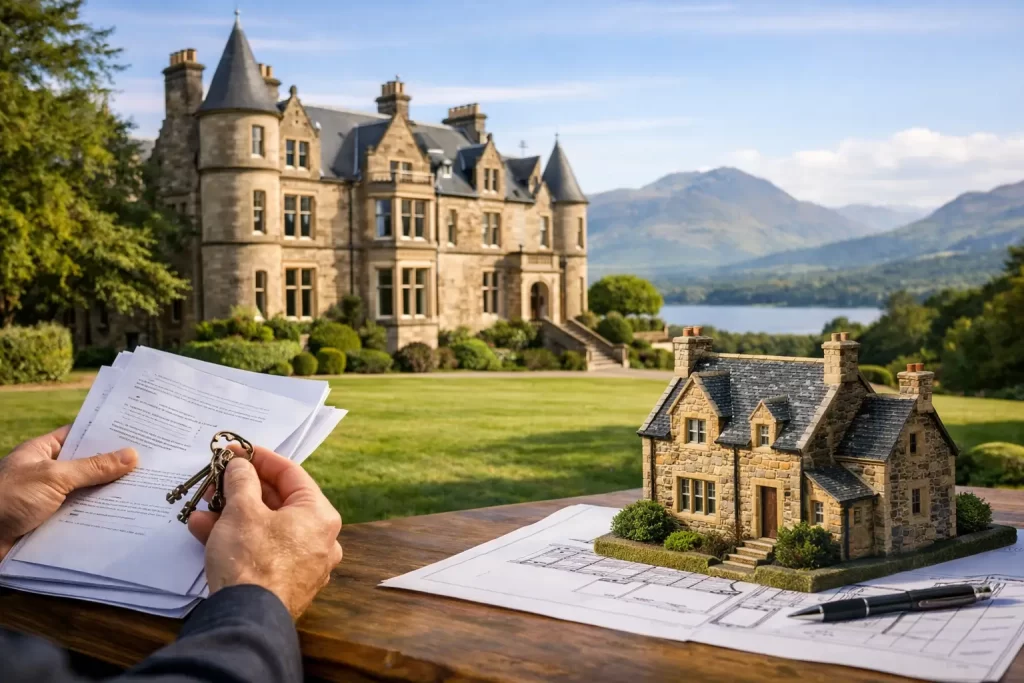


A handsome Victorian villa in Bridge of Allan, a contemporary family home in Kings Park, a stone cottage on the edge of the countryside – each may sit within the Stirling market, yet each will attract a different buyer and command a different price. That is why the question, how much is my house worth in Stirling, rarely has a useful answer until the detail is examined properly.
A credible valuation is not a quick guess based on postcode averages or a rough online estimate. It is a considered view of what a ready, willing and financially qualified buyer is likely to pay in the current market, for your particular home, under the right marketing strategy. In a market as varied as Stirling, precision matters.
How much is my house worth in Stirling really based on?
At its core, value is shaped by supply, demand and comparables. Yet those broad principles only tell part of the story. Two homes with the same number of bedrooms can achieve notably different results if one has a superior outlook, stronger school catchment, better room proportions or a more polished level of presentation.
In Stirling, location carries real weight, but micro-location often matters more than sellers expect. A home close to highly regarded schooling, attractive green space, commuter links or the historic heart of the city may hold stronger appeal than a similar property only a short drive away. Equally, villages and surrounding areas can command a premium when they offer a lifestyle buyers struggle to find elsewhere.
Condition is another major factor. Buyers will pay well for a home that feels cared for, coherent and easy to move into. That does not mean every property needs a full renovation before sale. In fact, over-improving can sometimes fail to return its cost. What matters more is whether the property presents as well maintained, well proportioned and aligned with the expectations of its target buyer.
Why online estimates only tell you so much
Online valuation tools can be useful as a starting point, but they are blunt instruments. They rely heavily on historic data, automated assumptions and broad property matching. They cannot properly assess the finish of your kitchen, the quality of your extension, the appeal of your garden room or the effect of an open outlook over the Ochils.
They also tend to struggle in markets where housing stock is diverse. Stirling is not an area of uniform developments with endless like-for-like evidence. It includes period homes, modern estates, rural properties, conversion flats and individual family houses, often within a short radius of one another. That variety is part of its appeal, but it makes automated pricing less reliable.
A digital estimate may therefore give you a range, but it will not tell you where your home should sit within that range, or whether buyer demand currently supports a stronger pricing strategy.
The local factors that influence value in Stirling
When assessing how much your house is worth in Stirling, local knowledge is not a luxury. It is essential. Buyers are not simply choosing a building. They are choosing a setting, a daily routine and a long-term lifestyle decision.
School catchments remain a consistent driver of demand, particularly for family homes. Access to independent and state schooling, as well as practical commuting routes to Edinburgh, Glasgow and Perth, can influence both urgency and budget. For professional buyers relocating into Central Scotland, convenience often sits alongside character and presentation.
There is also the question of property type. Detached homes with generous gardens can attract fierce competition in the right areas, while beautifully presented flats may perform strongly where downsizers, professionals and investors are active. Period features can enhance value, but only if the home also functions well for modern living. Buyers admire original cornicing and fireplaces, but they also notice storage, layout and natural light.
Even timing can play a role. The market does not move in a perfectly straight line. Seasonal confidence, stock levels and mortgage conditions all affect sentiment. A valuation should reflect current conditions, not last year’s headlines.
Comparable sales matter – but only when used properly
Most sellers understand that recent sales evidence helps determine value. That is true, but comparable evidence has to be interpreted with care. A nearby sale is only genuinely comparable if the homes are similar in size, style, condition and appeal.
This is where many informal estimates go astray. A four-bedroom house sold on the next street may look relevant, but if it had a newly completed extension, a larger plot or a superior finish throughout, it may support an entirely different price point. Equally, a lower sale nearby does not automatically drag your value down if your home offers better proportion, stronger kerb appeal or a more desirable setting.
A strong valuation balances data with judgement. It asks not only what sold, but why it sold at that level, who bought it, how it was presented and whether the same conditions apply to your home today.
Presentation can change the result
There is a difference between what a property is worth in theory and what it is likely to achieve in practice. Presentation often explains the gap.
Buyers make decisions quickly, especially online where first impressions shape whether a viewing is booked at all. A home that is carefully prepared, professionally photographed and brought to market with a clear strategy tends to generate stronger interest and better competition. That competition is often what pushes a sale beyond the level of a basic estimate.
Preparation does not always mean major spending. Sometimes the most effective changes are editing furniture, improving lighting, refreshing tired paintwork, attending to small defects and ensuring the exterior feels inviting. For premium homes in particular, consistency matters. Buyers expect quality to carry through from arrival to final viewing.
This is one reason premium estate agency advice can add real value. Pricing and presentation should work together, not as separate decisions.
When a higher asking price can backfire
It is natural to hope your property is worth more than recent evidence suggests. For some homes, that confidence is justified. For others, an ambitious launch can become expensive.
If a property comes to market too high, it may attract less early attention, remain available for longer and ultimately require a price reduction. Buyers notice that. Length of time on the market can weaken negotiating position, even when the home itself is strong. In contrast, a well-judged asking price can create momentum, encourage multiple viewings and lead to a firmer final result.
The right value is not always the highest possible number on paper. It is the figure most likely to secure meaningful interest from the right buyers within the right timeframe.
Should you value your home differently if you are not selling yet?
Sometimes the question is not about an immediate sale. You may be considering a move next year, weighing up a renovation, dealing with probate, reviewing your asset position or planning a portfolio decision. In these cases, valuation still matters, but the purpose changes.
If you are not selling straight away, it can be sensible to ask for both a present-day market valuation and a strategic view of what might improve value over time. That could include advice on whether a new kitchen is worthwhile, whether reconfiguring space would appeal to buyers, or whether waiting for a different market window is likely to help.
Good advice should be honest about trade-offs. Not every improvement adds pound-for-pound value. Some changes are more about saleability than headline price. Others may suit your own enjoyment of the home but do little to widen buyer demand.
Getting a more accurate answer
If you want a serious answer to the question how much is my house worth in Stirling, the best approach is a professional appraisal grounded in local evidence and current buyer behaviour. That means an in-person assessment, not just a desktop estimate.
A proper valuation should consider the measurable facts – size, plot, condition, tenure, recent sales – alongside the less obvious qualities that shape buyer response. It should also come with context. What kind of buyer is most likely to purchase your home? How should it be positioned? Is there a case for testing stronger demand, or is a more disciplined approach wiser?
For homeowners across Stirling and the surrounding villages, the most valuable guidance is rarely just a number. It is a strategy. At Halliday Homes, that strategy begins with understanding the home properly, then advising with clarity, discretion and a close reading of the local market.
Your home is worth what the market is prepared to pay for it – but with the right judgement, preparation and representation, that figure can be understood with far more confidence than any online tool will ever offer. If you are asking the question now, it may be exactly the right moment to look beyond estimates and seek a valuation that reflects the home you actually own.